
About Yasmin Herrera-Vilchez
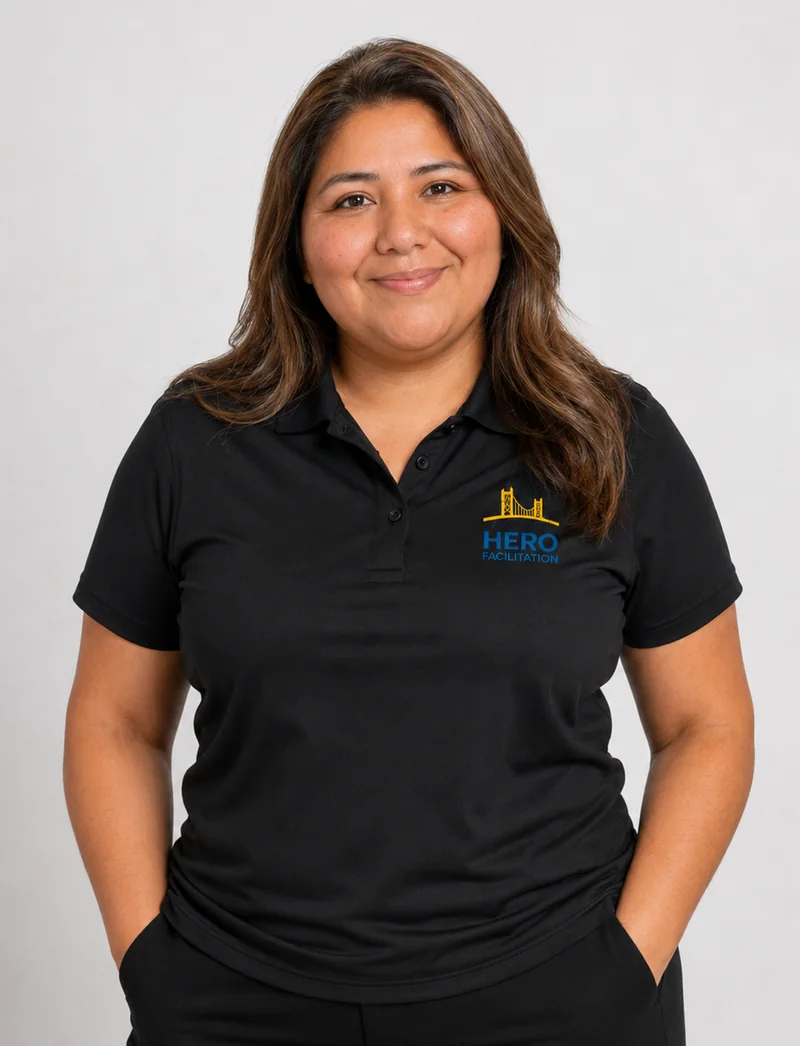
I'm Yasmin Herrera-Vilchez, founder of Hero Facilitation.
I provide person-centered planning, support for entering California's Self-Determination Program (SDP), and Independent Facilitation after enrollment.
Before I became an Independent Facilitator, I was a parent navigating systems that were not designed around my family. That experience shaped why Hero exists. It taught me how easily a person can disappear inside forms, funding rules, professional opinions, deadlines, and administrative processes—and how different a plan on paper can be from support that actually works in real life.
That difference matters to me.
Why choose me
I may be a good fit when there are several moving pieces and you want help keeping them connected without losing the participant in the process.
That might mean you are:
- planning for adulthood, work, community life, relationships, home, or more control over daily life;
- preparing for SDP or using person-centered planning to clarify direction;
- working through a budget, Spending Plan, FMS, providers, or workers;
- trying to make communication or language access work better;
- dealing with records or decisions that do not match; or
- trying to understand why something stalled or why approved support still has not become usable support.
I am comfortable with complicated situations, but complexity is not the point.
The point is the participant and the life they are trying to build.
Person-centered thinking is the foundation
My practice is grounded in person-centered thinking.
That means beginning with the participant instead of beginning with the system.
Person-centered planning helps make visible what matters to the participant: their strengths, communication, relationships, priorities, needs, hopes, and desired future.
As an Independent Facilitator, I can help carry that direction into informed choices, the IPP, the individual budget, services and supports, coordination, advocacy, and implementation.
The process can be substantial. The participant still sets the direction.
How I work
I ask questions.
I look at what happened.
I separate what is known from what still needs to be verified.
When a rule matters, I check the current source and what it actually applies to.
If better information changes my understanding, I change course.
I believe in respect and collaboration. I also do not think politeness should make an important question disappear.
“This is how we usually do it” can be useful information. It is not automatically the same as “this is what the rule requires.”
People are different. Planning should make room for that.
I do not assume what a good life looks like, what role a family should play, how someone should communicate, or which goals should matter most.
Culture, language, disability, family, community, relationships, identity, and lived experience can all shape what good support looks like.
Disability is part of human diversity. Person-centered planning is not a project of fixing the person.
The participant remains the author
Participants, families, supporters, interpreters, communication partners, and professionals may all contribute important information.
Those contributions are not interchangeable.
I work to keep clear:
- participant communication;
- supporter interpretation or report;
- professional recommendation;
- observed information;
- decisions; and
- uncertainty.
Self-determination does not mean doing everything alone. Support can be extensive. The participant can still be the author of their life.
English, Spanish, and communication access
I work in English and Spanish and coordinate other language access when needed.
I pay attention to how information is received and how the participant communicates. I do not expect someone to communicate like me in order to work with me.
Experience that informs my work
My experience as a parent and disability advocate helps me recognize barriers and understand why families may arrive with a long history, unanswered questions, or very little trust left in the process.
My experience helps me ask better questions. It does not tell me what another person wants. The participant's communication and direction remain the starting point.
My broader work includes healthcare access, children and families, disability policy, language access, and culturally responsive systems. That work informs Hero's attention to access and accountability, while Independent Facilitation remains the center of this practice.
Professional community
I am a member of Cal-IF, the California Association of Independent Facilitators.
Mission, vision & values
Mission. Support people with developmental disabilities in expressing and directing their choices, understanding their options, and connecting their plans with accessible, reliable supports that matter in everyday life.
Vision. Communities where people with developmental disabilities experience belonging, relationships, self-direction, accessible communication, meaningful opportunities, and the support needed to pursue the lives they choose.
Values. Participant direction; dignity; accessible communication; cultural and language inclusion; integrity; collaboration; accountability; evidence and continuous learning.
What you can expect from me
I will tell you what I understand and what I still need to verify.
I will keep the purpose of the work visible.
I will tell you when something is outside my role.
I will ask before expanding the work beyond what we agreed.
I will help make sure the participant's position and unresolved issues are accurately documented when that is part of the work.
I will not call an issue resolved just because a meeting happened, a form was signed, or an email was sent.
And I will not make decisions that belong to the participant.
You can ask questions, disagree, correct me, or ask me to explain something differently.